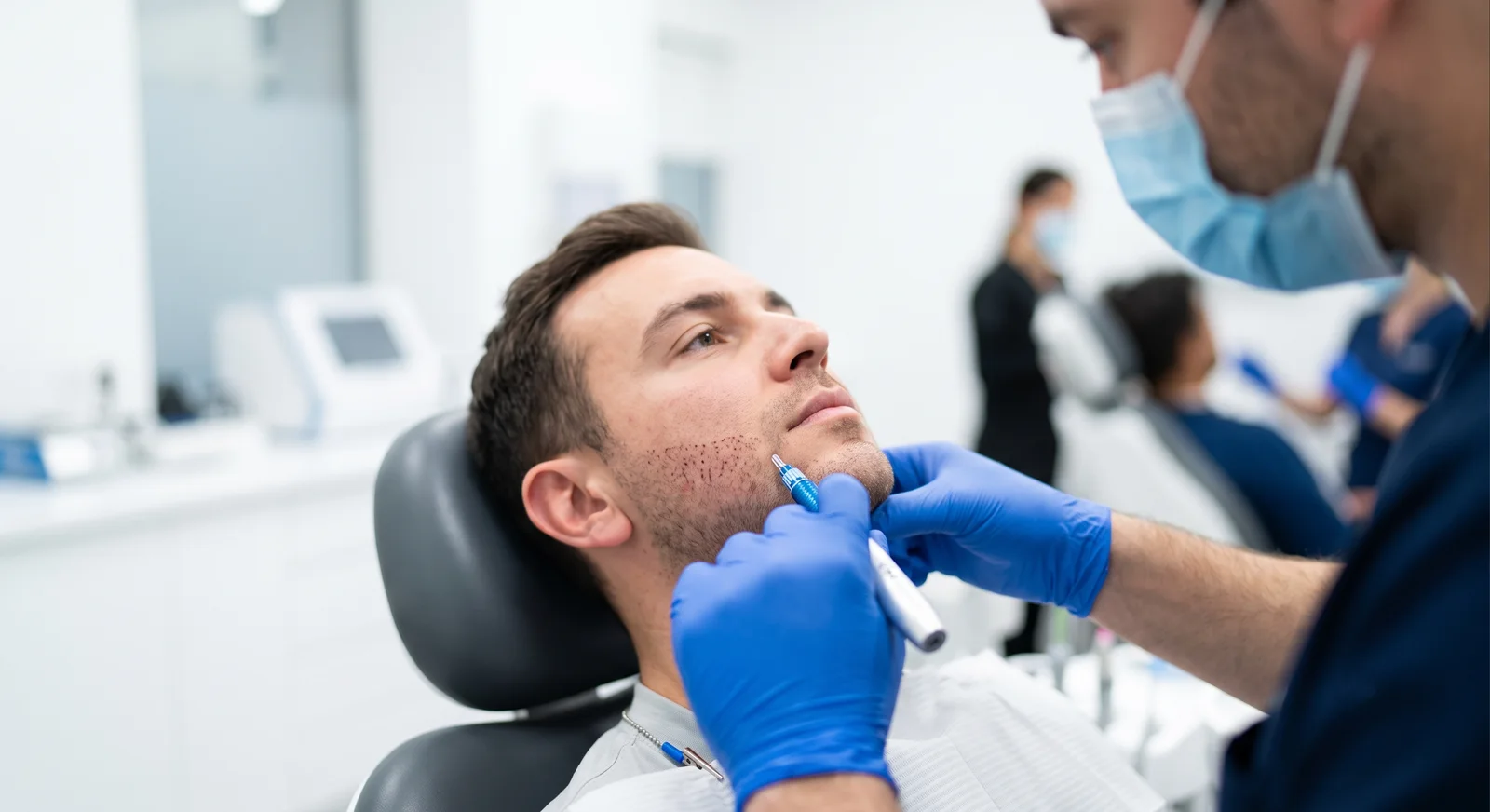

Fix Your Patchy Beard: The Permanent Solution for a Full, Masculine Look
Don't know
where to start ?
Find the right specialist with the best price guarantee
Pinpointing the root cause of a patchy beard
Why Do Beards Grow Patchy? Understanding the Root Cause
Before seeking a permanent solution, it’s important to understand why facial hair might be sparse. For the vast majority of men, patchiness is not a sign of poor hygiene or lack of care, but rather a biological reality. There are several primary factors that influence facial hair growth:
- Genetics: The most common cause is simply the DNA you inherited. Your androgen receptors might not be distributed evenly across your jawline, leading to areas where hair follicles are absent.
- Scarring and Trauma: Physical scarring from past injuries, burns, or severe acne can permanently damage the skin and the follicles beneath, creating smooth patches where hair cannot grow.
- Hormonal Imbalances: While testosterone plays a role, the way your body processes dihydrotestosterone (DHT) specifically at the follicle level determines the thickness and coverage of your beard.
- Medical Conditions: Conditions like alopecia areata can cause the immune system to attack hair follicles, resulting in circular bald spots on the face.
Unlike scalp hair, beard hair has a unique single-hair pattern and a much shorter growth phase. This means that once a follicle is absent or severely damaged, topical vitamins and serums rarely bring it back to life. Understanding these biological causes helps set realistic expectations for the density and coverage that can be achieved during a single session, ensuring the final result complements your existing facial hair texture and facial structure.
Why Do Beards Grow Patchy? Understanding the Root Cause
Before seeking a permanent solution, it’s important to understand why facial hair might be sparse. For the vast majority of men, patchiness is not a sign of poor hygiene or lack of care, but rather a biological reality. There are several primary factors that influence facial hair growth:
- Genetics: The most common cause is simply the DNA you inherited. Your androgen receptors might not be distributed evenly across your jawline, leading to areas where hair follicles are absent.
- Scarring and Trauma: Physical scarring from past injuries, burns, or severe acne can permanently damage the skin and the follicles beneath, creating smooth patches where hair cannot grow.
- Hormonal Imbalances: While testosterone plays a role, the way your body processes dihydrotestosterone (DHT) specifically at the follicle level determines the thickness and coverage of your beard.
- Medical Conditions: Conditions like alopecia areata can cause the immune system to attack hair follicles, resulting in circular bald spots on the face.
Unlike scalp hair, beard hair has a unique single-hair pattern and a much shorter growth phase. This means that once a follicle is absent or severely damaged, topical vitamins and serums rarely bring it back to life. Understanding these biological causes helps set realistic expectations for the density and coverage that can be achieved during a single session, ensuring the final result complements your existing facial hair texture and facial structure.
Pinpointing the root cause of a patchy beard
The Science of the Perfect Beard: How the Transplant Works
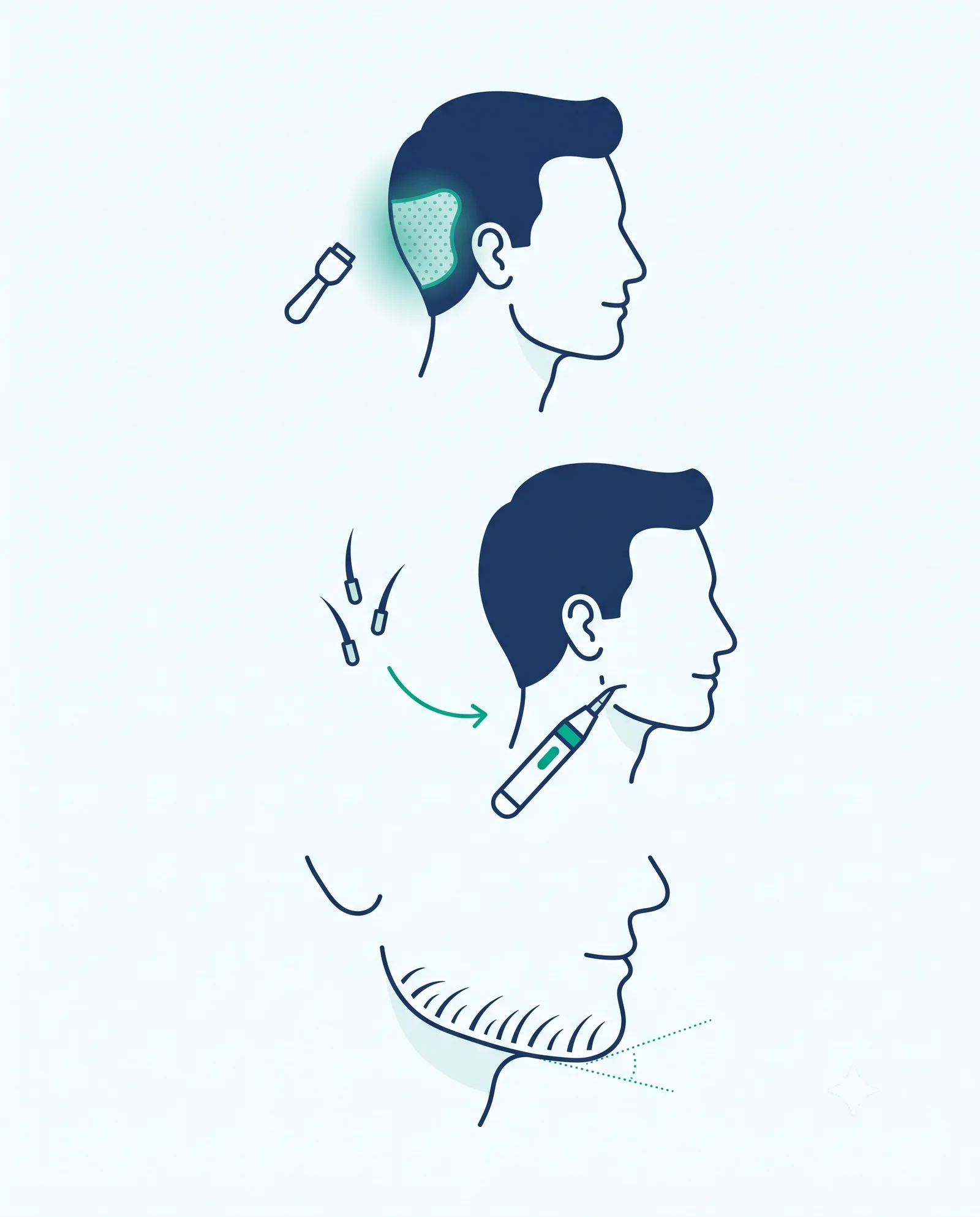
A beard transplant is a precise procedure that utilizes advanced surgical methods to move hair from one part of the body to the face. The process follows a very specific technical roadmap:
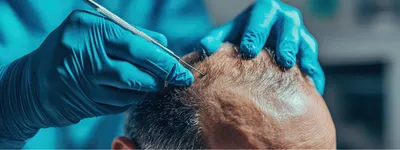
- The Extraction Phase: Healthy hair follicles are carefully harvested from the donor area, usually the back of the scalp. This area is chosen because the hair texture there is most similar to facial hair and is genetically resistant to falling out.
- The Choice of Technique: Surgeons typically use FUE (Follicular Unit Extraction) or DHI (Direct Hair Implantation). DHI is often preferred for beards because it allows for extreme precision without the need for pre-opened channels.
- Managing the Angle: Facial hair grows at much flatter angles than scalp hair, often as low as 10 to 20 degrees. If the follicles are implanted at the wrong angle, the beard will look stiff or artificial.
To avoid an unnatural appearance, only single-hair grafts are used for the outermost edges and contours of the beard line. This level of technical detail is what separates a standard medical procedure from a true aesthetic transformation. Healroad simplifies this technical selection process by vetting medical teams to ensure they have a proven track record in angle-specific beard implantation, allowing you to choose a clinic where surgeons are true aesthetic artists.
The Science of the Perfect Beard: How the Transplant Works
A beard transplant is a precise procedure that utilizes advanced surgical methods to move hair from one part of the body to the face. The process follows a very specific technical roadmap:
- The Extraction Phase: Healthy hair follicles are carefully harvested from the donor area, usually the back of the scalp. This area is chosen because the hair texture there is most similar to facial hair and is genetically resistant to falling out.
- The Choice of Technique: Surgeons typically use FUE (Follicular Unit Extraction) or DHI (Direct Hair Implantation). DHI is often preferred for beards because it allows for extreme precision without the need for pre-opened channels.
- Managing the Angle: Facial hair grows at much flatter angles than scalp hair, often as low as 10 to 20 degrees. If the follicles are implanted at the wrong angle, the beard will look stiff or artificial.
To avoid an unnatural appearance, only single-hair grafts are used for the outermost edges and contours of the beard line. This level of technical detail is what separates a standard medical procedure from a true aesthetic transformation. Healroad simplifies this technical selection process by vetting medical teams to ensure they have a proven track record in angle-specific beard implantation, allowing you to choose a clinic where surgeons are true aesthetic artists.
Designing Your New Look: The Art of Facial Symmetry
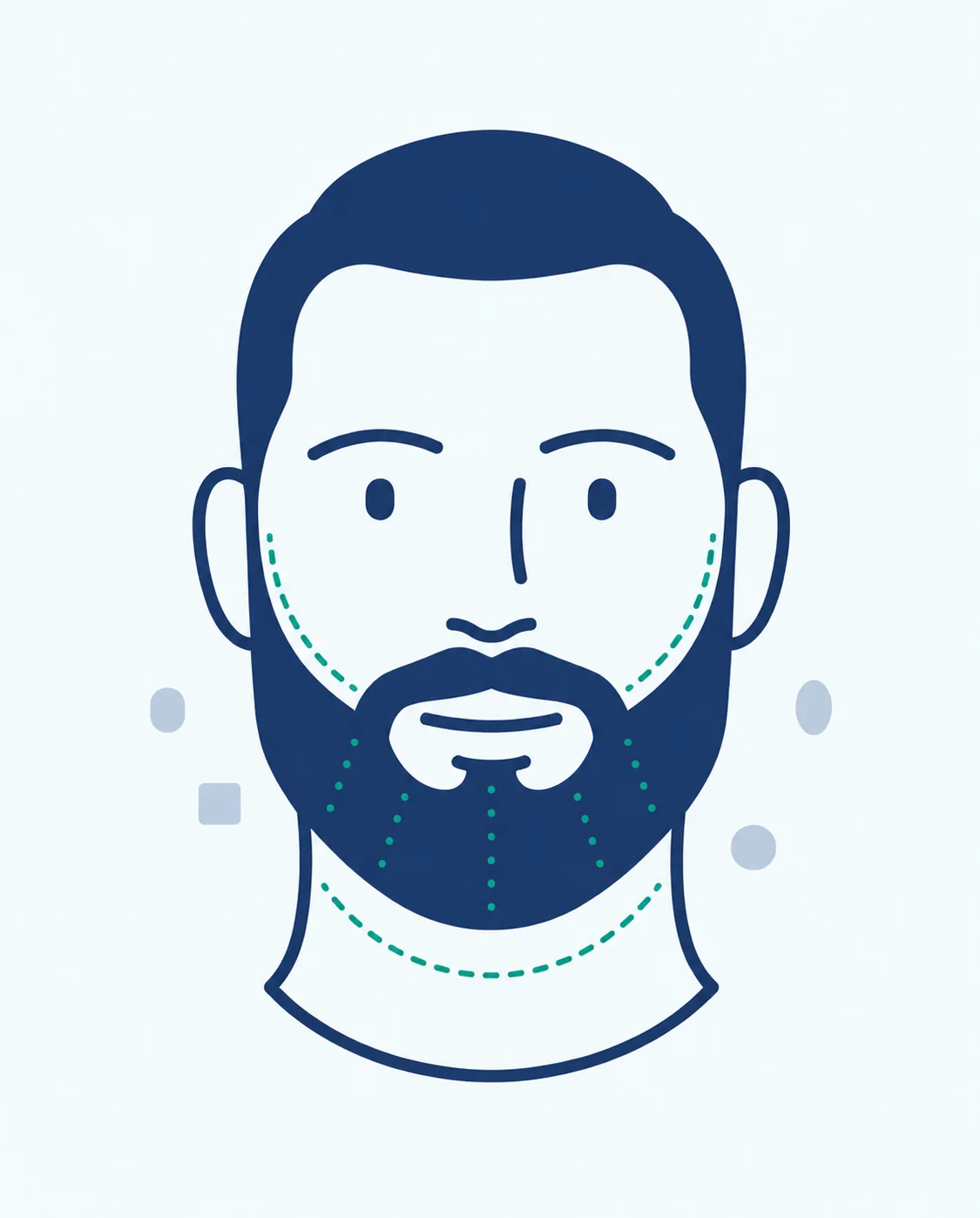
The most critical part of a beard transplant isn't just the surgery itself, it is the aesthetic design. A beard line that is placed too high on the cheeks or too low on the neck can disrupt your natural facial harmony. The design process focuses on three key areas:
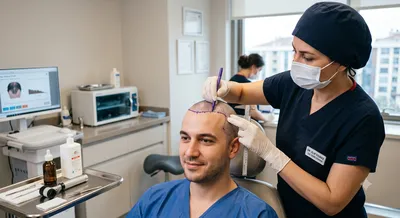
- The Cheek Line: This line defines the top border of your beard. It must be drawn to enhance your jawline and cheekbones without looking like a straight, artificial line.
- The Neck Line: A natural beard has a soft transition at the neck. Designing this correctly prevents the "taped-on" look and ensures the beard looks natural even when you tilt your head.
- Density Gradient: Natural beards are often slightly thinner at the very top and thicker near the chin. A skilled surgeon recreates this gradient to mimic biological growth patterns.
During the planning phase, every millimeter counts. The surgeon must carefully consider your unique face shape, whether it is square, oval, or round, to ensure the new beard contours complement your symmetry. Since transplanted follicles are genetically resistant to thinning, this new design becomes a permanent part of your profile. This meticulous attention to design ensures that the final result provides a sharp, clean profile from every angle, looking entirely natural even under close inspection.
Designing Your New Look: The Art of Facial Symmetry
The most critical part of a beard transplant isn't just the surgery itself, it is the aesthetic design. A beard line that is placed too high on the cheeks or too low on the neck can disrupt your natural facial harmony. The design process focuses on three key areas:
- The Cheek Line: This line defines the top border of your beard. It must be drawn to enhance your jawline and cheekbones without looking like a straight, artificial line.
- The Neck Line: A natural beard has a soft transition at the neck. Designing this correctly prevents the "taped-on" look and ensures the beard looks natural even when you tilt your head.
- Density Gradient: Natural beards are often slightly thinner at the very top and thicker near the chin. A skilled surgeon recreates this gradient to mimic biological growth patterns.
During the planning phase, every millimeter counts. The surgeon must carefully consider your unique face shape, whether it is square, oval, or round, to ensure the new beard contours complement your symmetry. Since transplanted follicles are genetically resistant to thinning, this new design becomes a permanent part of your profile. This meticulous attention to design ensures that the final result provides a sharp, clean profile from every angle, looking entirely natural even under close inspection.
Beard Transplant
Recovery and Life After
A simple view of what changes over time
Settle-in phase
The first days are about protecting the grafts and keeping care gentle.
Reset moment
Early shedding can happen. It is usually part of the normal growth cycle.
Visible progress
New growth becomes more consistent and coverage starts to feel real.
Final outcome
The result typically stabilizes and the beard looks its most natural.
Tip: A clear follow-up plan matters. Good clinics guide washing, protection, and check-ins so recovery feels predictable.
Recovery and Life After the Transplant
The recovery process for a beard transplant is surprisingly quick compared to other surgical procedures. Most patients are surprised at how fast they can return to their daily routines. Here is what you can expect during the healing journey:
- Days 1 to 5: You may notice minor redness or tiny crusts around the newly implanted follicles. This is a sign of the skin healing and the grafts taking root.
- Week 3: A process called shock loss occurs, where the transplanted hairs fall out. This is a normal part of the cycle and makes way for new, permanent growth.
- Months 3 to 6: The new follicles begin to produce strong, permanent hair. By the six-month mark, you will see a significant increase in density and coverage.
- Month 12: The full result is visible, and the beard reaches its maximum thickness.
This entire transformation requires careful post-operative hygiene, including specific washing techniques and avoiding direct pressure, to protect the delicate new grafts during the critical first few days of healing. Healroad stands by you throughout this transformation by providing a dedicated follow-up schedule and expert advice on after-care, ensuring you are never alone as you wait for your new masculine look to reach its full potential.
Recovery and Life After the Transplant
The recovery process for a beard transplant is surprisingly quick compared to other surgical procedures. Most patients are surprised at how fast they can return to their daily routines. Here is what you can expect during the healing journey:
- Days 1 to 5: You may notice minor redness or tiny crusts around the newly implanted follicles. This is a sign of the skin healing and the grafts taking root.
- Week 3: A process called shock loss occurs, where the transplanted hairs fall out. This is a normal part of the cycle and makes way for new, permanent growth.
- Months 3 to 6: The new follicles begin to produce strong, permanent hair. By the six-month mark, you will see a significant increase in density and coverage.
- Month 12: The full result is visible, and the beard reaches its maximum thickness.
This entire transformation requires careful post-operative hygiene, including specific washing techniques and avoiding direct pressure, to protect the delicate new grafts during the critical first few days of healing. Healroad stands by you throughout this transformation by providing a dedicated follow-up schedule and expert advice on after-care, ensuring you are never alone as you wait for your new masculine look to reach its full potential.
Beard Transplant
Recovery and Life After
A simple view of what changes over time
Settle-in phase
The first days are about protecting the grafts and keeping care gentle.
Reset moment
Early shedding can happen. It is usually part of the normal growth cycle.
Visible progress
New growth becomes more consistent and coverage starts to feel real.
Final outcome
The result typically stabilizes and the beard looks its most natural.
Tip: A clear follow-up plan matters. Good clinics guide washing, protection, and check-ins so recovery feels predictable.
Conclusion
Fixing a patchy beard is about more than just hair; it’s about reclaiming your confidence and feeling comfortable in your own skin. With the right technique and a surgeon’s artistic touch, a permanent, full, and masculine beard is well within your reach. Beard transplantation offers a life-changing solution for those who have struggled with sparse growth for years. At Healroad, we take the stress out of the selection process by offering a transparent, independent platform where you can compare the world’s best beard transplant specialists. We manage the logistics, verify the quality, and support your recovery so that you can focus on the results. Whether you are looking for a subtle density boost or a complete beard reconstruction, let Healroad be your guide to finding the perfect clinic and achieving the look you deserve. Contact us today to receive personalized offers and take the first step toward a new you.
Article Contributors

Emin Albayrak
Writer
- Views
- 1627 views
- Reading Time
- Last Updated